

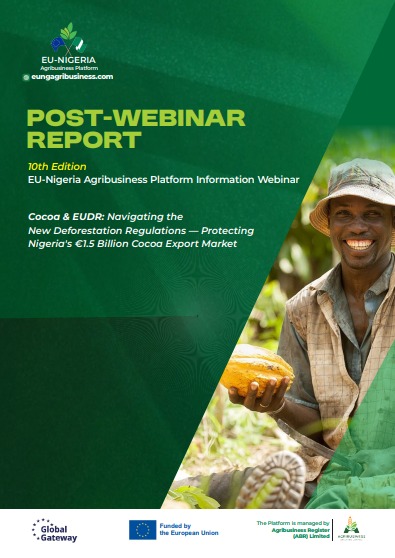
EUDR Compliance: The Green Passport for Nigerian Cocoa
Protecting Nigeria’s €1.5 Billion Cocoa Export Market
📋 Executive Summary
The 10th Edition of the EU-Nigeria Agribusiness Information Webinar, held on February 19, 2026, convened 52 stakeholders from government, private sector, development finance, and research institutions to address an urgent regulatory challenge: Nigeria’s compliance readiness for the EU Deforestation Regulation (EUDR).
⚠️ Critical Timeline Alert
With approximately 80% of Nigeria’s cocoa exports—valued at €1.5 billion annually—destined for the EU market, the EUDR represents both a significant market risk and a transformational opportunity.
Key Compliance Deadlines:
- December 31, 2026: Large operators must be fully compliant
- June 30, 2027: SMEs and smallholders must comply
The session featured high-level government opening remarks from the Federal Ministries of Agriculture and Industry, a technical compliance briefing from NICERT/Naiset Expert Consulting, live platform demonstrations of Food Sign and Clear Up traceability tools, and a structured stakeholder debate.
💰 Financial Support Confirmed
The EU Delegation confirmed two major funding mechanisms:
- €18 million in dedicated EU-GIZ compliance support
- €190 million mobilized through Bank of Industry (BOI) and FCMB
🎯 Webinar Objectives & Expected Outcomes
The webinar was strategically designed to deliver three core outcomes:
Strategic Clarity
Strategic and technical clarity on EUDR compliance requirements for Nigerian cocoa stakeholders
Risk Assessment
An honest risk assessment of the threat posed to Nigeria’s €1.5 billion cocoa export market
Actionable Pathways
Actionable, practical compliance pathways for producers, exporters, aggregators, and policymakers
These objectives were reinforced across all sessions and were largely achieved by the close of the event.
👥 Stakeholder Participation
The webinar attracted 52 participants representing a cross-section of Nigeria’s cocoa and agribusiness ecosystem:
| Participating Institution / Sector | Representative Category |
|---|---|
| Federal Ministry of Agriculture & Food Security | Government – Policy & Regulation |
| Federal Ministry of Industry, Trade & Investment | Government – Trade Policy |
| Cocoa Research Institute of Nigeria (CRIN) | Research & Academia |
| EU Delegation to Nigeria & ECOWAS | Development Partner |
| NICERT / NICERT Expert Consulting Ltd | Technical & Certification |
| Food Sign / Clear Up (Trace X) | Technology Providers |
| Private Sector Exporters & Consultants | Industry |
| Diaspora Stakeholders | International Engagement |
🏛️ High-Level Government Commitment
Federal Ministry of Agriculture & Food Security
Dr. Aisha Aliyu delivered the ministry’s address, framing EUDR compliance as both strategic and symbolic.
Economic Stakes
- Over $1 billion in direct export earnings at risk
- Over $3 billion in broader economic value threatened
- Requires a unified national response
Federal Ministry of Industry, Trade & Investment
Mr. Oladele Oluwafemi confirmed Nigeria’s position as Africa’s fourth-largest cocoa producer and emphasized EUDR compliance as a national policy imperative rather than a burden.
Key Commitments:
- Ministry working with state governments to harmonize export systems
- National task force active on legality harmonization
- Industry compliance structuring underway
🔍 The Five Pillars of EUDR Compliance
Mr. Victor Ezenwa of NICERT/NICERT Expert Consulting Limited outlined the mandatory compliance framework:
Geolocation Mapping
- All farms must be GPS-mapped
- Farms >4 hectares require polygon mapping
- Formats: GeoJSON, KML, Shapefile
- Must exclude deforested ‘red zones’
Due Diligence & Risk Assessment
- Satellite + GIS classification
- Risk levels: High/Medium/Low
- Mitigation plans required
- Continuous monitoring
Legal Compliance
- Proof of legal cultivation rights
- Community head attestations accepted
- Supplements formal land titles
- State harmonization essential
Farm-to-Port Traceability
- Full chain-of-custody tracking
- Farm to export point coverage
- Prevent mixed sourcing
- Digital platforms preferred
Ongoing Monitoring
- Post-2020 deforestation verification
- Dec 31, 2026 (large operators)
- Jun 30, 2027 (SMEs/smallholders)
- Regular compliance audits
💻 Technology Solutions: Food Sign & Clear Up
The webinar featured live demonstrations of integrated compliance platforms by Trace X, NICERT’s technology partner:
Food Sign
First-Mile Traceability Platform
- Farmer Registration: Unique ID generation with documentation
- Walk-and-Plot Mapping: Real-time farm boundary mapping via mobile
- Harvest Tracking: Quantity and timing linked to storage
- Custom Dashboards: Field officer performance and farm analytics
- Multi-Plot Management: Per-farmer plot tracking
Clear Up
Compliance & Risk Assessment Platform
- GeoJSON Processing: Automated deforestation risk scoring
- Satellite Monitoring: Post-2020 forest conversion detection
- Automated DDS: Due Diligence Statements as PDFs
- Buyer Portal: EU buyer transparency access
- Real-Time Alerts: Non-compliant land use flagging
🔗 Integrated Compliance Pipeline
The integration of Food Sign and Clear Up delivers a farm-to-export compliance pipeline that:
- ✓ Reduces manual intervention
- ✓ Supports real-time risk monitoring
- ✓ Meets EU regulatory formatting standards
- ✓ Enables transparent buyer engagement
⚠️ Nigeria’s Current Compliance Gaps
Six critical weaknesses were identified in Nigeria’s cocoa supply chain:
- Incomplete farm mapping – Missing GPS plot data across major cocoa-growing states
- Poor traceability – Mixed sourcing at village and aggregator levels
- Weak documentation – Limited record-keeping at farm level
- Low farmer awareness – Significant knowledge gaps on EUDR requirements
- Absence of standardized risk assessment – No uniform procedures
- Inconsistent legality verification – Variations across states
⚡ These gaps represent urgent intervention points for both government and private sector actors.
📊 NICERT’s Proven Track Record
NICERT/NICERT Expert Consulting presented completed compliance engagements as proof of concept:
🌳 Valency Limited
Location: Cross River & Ondo States
Scale: 12,000 hectares
Deliverables:
- Complete farmer profiles
- GPS coordinates mapped
- Polygon data generated
- Due Diligence Statements (DDS) completed
🍫 Moi Food
Location: Southwest Nigeria
Scale: 4,000 hectares
Deliverables:
- Complete cocoa compliance mapping
- Traceability systems deployed
- Risk assessment completed
🚜 Saro Agro (Ongoing)
Location: Benue & Nasarawa States
Status: Active engagement
Services:
- Farm mapping in progress
- Compliance framework development
- Technology platform deployment
💬 Key Stakeholder Concerns & Responses
1. EU Delegation Clarifications
Mr. Hugh Briggs of the EU Delegation to Nigeria and ECOWAS provided critical clarifications:
- ✓ EUDR does not compel exports to Europe
- ✓ All products entering EU must meet uniform traceability standards
- ✓ Regulation is environmental, not political
- ✓ Applies equally to EU domestic producers
2. Smallholder Burden
Concerns Raised:
- Affordability of mapping for smallholders
- Accessibility of digital tools
- Capacity gaps at farm level
Solutions Provided:
- Cooperative-level aggregation reduces per-farmer costs
- Satellite mapping significantly reduces manual burden
- Extension officer deployment being explored by government
- EU funding specifically allocated for smallholder support
3. Land Tenure & National Coordination
Dr. Dele Adeniji (CRIN) questioned coordination adequacy across governance levels.
Government Response (FMITI):
- ✓ National task force actively working
- ✓ Legality harmonization underway
- ✓ Single national database being developed
- ✓ State-level integration ongoing
4. Value Addition Opportunity
⚖️ Strategic Implications: Risks vs. Opportunities
❌ Risks of Non-Compliance
- Exclusion from €1.5B EU cocoa market
- Revenue decline and competitive displacement
- Reputational damage for exporters and buyers
- Supply chain fragmentation
- Loss of EU buyer relationships
- Fines up to 4% of EU buyer turnover
- Product confiscation at ports
- Permanent market exclusion
✅ Opportunities from Compliance
- Scarcity premiums as competitors exit
- Carbon credit monetization
- Green finance and sustainable investment access
- Data-driven sector reform
- Stronger EU investment alignment
- Enhanced B2B opportunities
- Premium market positioning
- Operational efficiency gains
📋 Strategic Recommendations
For Government
- Finalize and publish national cocoa traceability framework
- Establish central national traceability database
- Support satellite mapping partnerships at scale
- Deploy farmer awareness programs in cocoa states
- Accelerate national task force outputs
- Harmonize land tenure documentation
For Private Sector
- Immediately adopt digital traceability platforms
- Aggregate farmer data at cooperative level
- Explore carbon credit frameworks
- Engage with EUNAP for EU buyer matchmaking
- Invest in supply chain transparency
- Build compliant supply chains now
For EUNAP
- Publish official post-webinar communiqué
- Host follow-up technical sessions
- Facilitate EU-Nigeria B2B matchmaking
- Develop compliance tracking dashboard
- Provide ongoing regulatory updates
- Support sector coordination efforts
📅 About This Webinar
EU-Nigeria Agribusiness Information Webinar (10th Edition)
Thursday, February 19, 2026
11:00 AM – 12:45 PM (WAT)
Zoom (Virtual)
EU-Nigeria Agribusiness Platform (EUNAP)
Mr. Nathaniel Odiba
NICERT Ltd
52 registered stakeholders
European Union
Agribusiness Register Limited
Take Action Now: Secure Your EU Market Access
The clock is ticking. With the December 2026 deadline approaching, early compliance movers will gain significant competitive advantages.
🎯 Conclusion: The Time for Action is Now
The 10th Edition EUNAP Information Webinar delivered a clear and unambiguous message to Nigeria’s cocoa sector: the EU Deforestation Regulation is operational, the compliance clock is running, and the window for preparatory action is narrowing rapidly.
The Stakes
With €1.5 billion in annual export value at stake, the cost of inaction far exceeds the investment required to build a compliant, traceable, and sustainable cocoa supply chain.
The Path Forward
The webinar demonstrated that:
- ✓ Practical solutions exist (Food Sign, Clear Up platforms)
- ✓ EU funding is available (€208 million committed)
- ✓ Government is mobilizing (national task force active)
- ✓ But coordination, speed, and execution are now decisive
Nigeria must transition decisively from awareness to structured implementation to protect its position in the European market and to leverage EUDR compliance as a platform for sustainable sector transformation.