

Overview
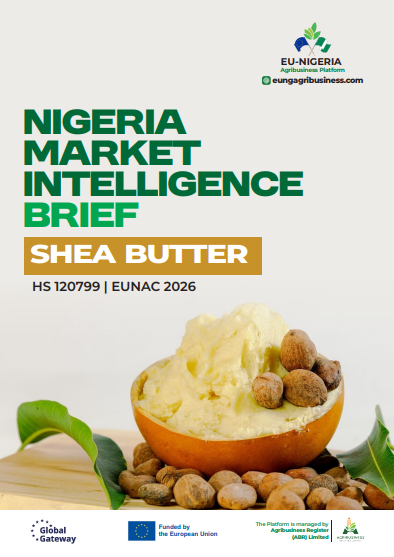
Shea butter is produced exclusively within a 5,400 km sub-Saharan African belt — Europe relies entirely on West African origins. The EU imported USD 612.2 million in 2024 across four growing demand segments: confectionery CBE fats, personal care & cosmetics, food ingredients, and oleochemicals.
Nigeria holds 57% of the world’s shea tree population yet exports just USD 4.3 million to the EU — a structural underperformance with a clear, solvable cause. Shea butter is a wild-harvested crop from indigenous agroforestry systems — shea trees grow naturally in savanna landscapes and are not cultivated on cleared forestland.
This biological reality gives Nigerian shea an inherent EUDR compliance advantage: shea trees are naturally occurring in savanna zones, not planted on deforested land, making Nigerian shea inherently compliant with EU Deforestation Regulation requirements without requiring complex traceability systems.
Four EU Demand Segments
Nigeria’s shea export strategy must address all four EU demand segments simultaneously, since they draw from the same refined butter supply but target different processing pathways and buyers:
Segment: CBE / Confectionery Fats
FFA Specification: ≤2%
Key EU Buyers: AAK, Bunge Loders Croklaan, Fuji Oil
Price: EUR 1,400–1,800
Segment: Personal Care / Cosmetics
FFA Specification: ≤5% FFA (≤2% premium)
Key EU Buyers: L’Oréal, Unilever, Beiersdorf, Clarins
Price: EUR 1,200–1,600
Segment: Food Ingredients
FFA Specification: ≤2% FFA (Codex/EU)
Key EU Buyers: Kerry Group, Puratos, AAK Food, infant formula manufacturers
Price: EUR 1,500–2,000
Segment: Oleochemicals
FFA Specification: FFA distillate
Key EU Buyers: Oleon, CREMER OLEO, Stepan, Procter & Gamble Chemicals
Price: USD 500–700/MT distillate
Note: CBE refers to Cocoa Butter Equivalents — shea stearin replaces costly cocoa butter in compound chocolate formulations.
key opportunities
Nigeria's Inherent EUDR Advantage
Shea butter is a wild-harvested crop from indigenous agroforestry systems — shea trees grow naturally in savanna landscapes and are not cultivated on cleared forestland. This biological reality gives Nigerian shea an inherent EUDR compliance advantage that requires no complex traceability infrastructure. While cocoa, palm oil, and soybean face expensive EUDR compliance costs, Nigerian shea is naturally compliant.
The CDI NSDP Six-Plant Programme
The Centre for Development and Innovation (CDI) Nigeria Shea Development Programme (NSDP) is deploying six industrial refining plants with combined capacity of 84,000 MT/year refined butter. These plants use mechanical expeller extraction and physical refining to produce EU-compliant shea butter at:
- ≤2% FFA for CBE/confectionery and food ingredients segments
- ≤5% FFA for personal care/cosmetics segment
- FFA distillate as oleochemical feedstock (4,700–8,000 MT/year)
This infrastructure eliminates Nigeria's historical barrier: traditional hot-water extraction produces 8–15% FFA butter that fails EU commercial thresholds.
Investment Opportunities
- NSDP Six-Plant Programme: European strategic industrial partner sought (AAK, Bunge Loders Croklaan, or Oleon) for technical co-investment plus guaranteed multi-year offtake; USD 15–25M.
- Nigeria Shea Fairtrade Certification: EUR 8–12M in cooperative training, auditing infrastructure, and digital certification for 350,000+ women collectors. Fairtrade certification is increasingly standard for EU personal care buyers (L'Oréal, Unilever, Clarins).
- FFA Distillate Offtake: Immediate commercial contract opportunity for Oleon or CREMER OLEO — 4,700–8,000 MT/year at USD 500–700/MT CIF Rotterdam. FFA distillate is a valuable oleochemical feedstock for surfactants and industrial applications.
Four-Segment Market Strategy
Nigerian shea can simultaneously serve all four EU demand segments from the same refined butter supply:
CBE / Confectionery
~40% of EUR 612M market
Replace cocoa butter in compound chocolate
Personal Care
~35% of market, 6.4% CAGR
Traceable + Fairtrade certified supply
Food Ingredients
~15% of market
Bakery fats, infant formula applications
Oleochemicals
~10% of market
FFA distillate for surfactants
Women's Economic Empowerment
Shea collection in Nigeria employs an estimated 350,000+ women across the Northern savanna belt. Fairtrade certification, cooperative training, and improved collection practices can deliver 30-50% income increases while ensuring EU-compliant supply chains.
key challenges
- FFA Content Barrier: Traditional hot-water extraction produces shea butter at 8–15% FFA, which is above EU commercial thresholds (≤2% for CBE/food segments, ≤5% for cosmetics). This is the root cause of Nigeria's structural underperformance despite holding 57% of global shea tree population.
- Lack of Industrial Refining Capacity: Nigeria needs mechanical expeller extraction and physical refining infrastructure to produce EU-compliant low-FFA shea butter. The CDI NSDP Six-Plant Programme addresses this but requires USD 15-25M in European strategic partner co-investment.
- Fairtrade Certification Gap: EU personal care buyers (L'Oréal, Unilever, Beiersdorf, Clarins) increasingly require Fairtrade-certified shea butter. Nigeria's 350,000+ women collectors need cooperative training, auditing infrastructure, and digital certification systems (EUR 8-12M investment).
- Multiple Competing Demand Segments: EU shea market has four distinct segments (CBE/confectionery, personal care, food ingredients, oleochemicals) with different FFA specifications, buyer requirements, and price points. Nigerian exporters must simultaneously serve all segments to maximize market share.
- Competition from Established Origins: Ghana, Burkina Faso, and Mali have established EU supply relationships and Fairtrade-certified cooperatives. Nigeria must differentiate on EUDR compliance advantage and scale (57% global tree share).
- Quality Consistency: Wild-harvest nature of shea collection creates quality variability. Need for standardized collection protocols, sorting infrastructure, and quality control systems to meet EU buyer specifications consistently.
- Limited Offtake Agreements: Industrial refiners need guaranteed multi-year offtake contracts from European buyers (AAK, Bunge Loders Croklaan, Oleon, L'Oréal) to justify USD 15-25M capital investment in processing infrastructure.
target markets
Four EU Demand Segments
Nigeria's shea export strategy targets all four EU demand segments simultaneously:
1. CBE / Confectionery Fats (~40% of market)
- Application: Shea stearin replaces costly cocoa butter in compound chocolate
- FFA Requirement: ≤2% FFA
- Price: EUR 1,400–1,800/MT
- Key Buyers: AAK (Sweden/Netherlands), Bunge Loders Croklaan (Netherlands), Fuji Oil (Belgium)
2. Personal Care / Cosmetics (~35% of market, 6.4% CAGR)
- Application: Skincare, haircare, natural cosmetics formulations
- FFA Requirement: ≤5% FFA (≤2% FFA commands premium pricing)
- Additional Requirements: Traceable origin, Fairtrade certification increasingly standard
- Price: EUR 1,200–1,600/MT
- Key Buyers: L'Oréal (France), Unilever (Netherlands/UK), Beiersdorf (Germany), Clarins (France)
3. Food Ingredients (~15% of market)
- Application: Bakery fats, infant formula, specialty food ingredients
- FFA Requirement: ≤2% FFA (Codex/EU standards)
- Price: EUR 1,500–2,000/MT
- Key Buyers: Kerry Group (Ireland), Puratos (Belgium), AAK Food (Sweden), infant formula manufacturers
4. Oleochemicals (~10% of market)
- Application: Surfactants, industrial applications, biodegradable chemicals
- Product: FFA distillate (byproduct of physical refining)
- Volume: 4,700–8,000 MT/year from NSDP capacity
- Price: USD 500–700/MT CIF Rotterdam
- Key Buyers: Oleon (Belgium), CREMER OLEO (Germany), Stepan (Netherlands), Procter & Gamble Chemicals
Geographic Markets
- Netherlands: Rotterdam entry port for bulk shea butter; home to AAK, Bunge Loders Croklaan, Unilever
- Belgium: Fuji Oil, Puratos, Oleon operations; Antwerp port alternative
- Germany: Beiersdorf, CREMER OLEO, processing and re-export hub
- France: L'Oréal, Clarins — premium cosmetics demand
- Sweden/UK/Ireland: AAK headquarters, secondary processing facilities
Key EU Buyers by Segment
AAK
- Country: Sweden/Netherlands
- Segment: CBE, Food
- Description: Global leader in specialty vegetable fats; largest shea butter processor in EU
Bunge Loders Croklaan
- Country: Netherlands
- Segment: CBE, Food
- Description: Major oilseed processor and CBE manufacturer
Fuji Oil
- Country: Belgium
- Segment: CBE, Food
- Description: Japanese confectionery fats specialist; EU operations in Belgium
L'Oréal
- Country: France
- Segment: Personal Care
- Description: World's largest cosmetics company; sustainable sourcing commitment; Fairtrade preferred
Unilever
- Country: Netherlands/UK
- Segment: Personal Care
- Description: Major buyer for Dove, Vaseline, personal care brands; traceable supply chains required
Beiersdorf
- Country: Germany
- Segment: Personal Care
- Description: Nivea brand manufacturer; premium cosmetics formulations
Clarins
- Country: France
- Segment: Personal Care
- Description: Premium French cosmetics; ethical sourcing requirements
Kerry Group
- Country: Ireland
- Segment: Food Ingredients
- Description: Global taste and nutrition company; specialty food fats buyer
Puratos
- Country: Belgium
- Segment: Food Ingredients
- Description: Bakery, patisserie, chocolate ingredients supplier
Oleon
- Country: Belgium
- Segment: Oleochemicals
- Description: Europe's largest oleochemicals producer; FFA distillate buyer
CREMER OLEO
- Country: Germany
- Segment: Oleochemicals
- Description: Specialty oleochemicals trader; FFA distillate offtake opportunity
Stepan
- Country: Netherlands
- Segment: Oleochemicals
- Description: Surfactant manufacturer; bio-based chemical feedstock buyer
P&G Chemicals
- Country: Belgium/Germany
- Segment: Oleochemicals
- Description: Procter & Gamble chemical division; industrial oleochemical applications