

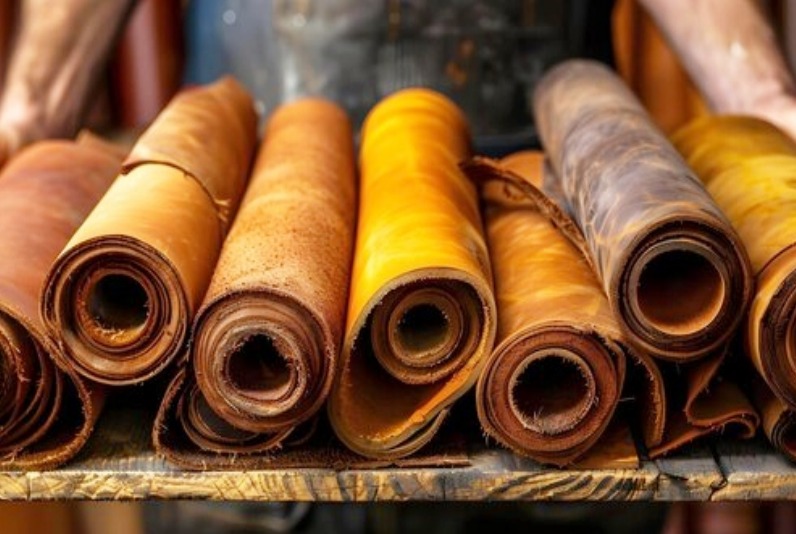
The Nigerian leather industry remains one of the country’s strongest non-oil export sectors, with significant potential for value addition and increased foreign exchange earnings. Our leather ranks amongst the highest quality globally. Currently, Nigeria exports mainly semi-processed goat and sheep skins (HS 4106) to the EU, with 2023 exports valued at approximately US$10.9 million.
However, Nigeria’s participation in higher-value finished leather (HS 4107) and leather goods is negligible. Key production clusters are in Kano, Kaduna, Sokoto (tanning), and Aba, Lagos (footwear/leather goods). Challenges include compliance with EU standards, limited finishing capacity, and environmental issues.
Several research and technology institutes in the EU could provide technical support for Nigeria’s transition into higher-value segments.
Current State of the Nigeria Leather Industry & Associations
Nigeria is a major producer of goat and sheep skins, historically recognized for the high quality of ‘Sokoto Red’ goat skins. The tanning industry is concentrated in Kano, Kaduna, and Sokoto, while footwear and leather goods clusters are based in Aba and Lagos. The industry is estimated to employ hundreds of thousands across its value chain. The sector’s competitiveness is constrained by aging equipment, inadequate power supply, limited compliance with international standards, and environmental concerns.
Key Associations:
-
Leather & Allied Products Manufacturers Association of Nigeria (LAPAN)
-
Hides & Skin Dealers Association of Nigeria
-
Manufacturers Association of Nigeria (Leather & Footwear Group)
-
Nigerian Export Promotion Council (NEPC) Leather Desk
Nigeria’s Leather Exports to the EU (5-Year View)
Italy and Spain are the largest destinations of Nigerian leather in total, covering over 71% of total Nigerian exports. Nigeria’s exports to the EU are dominated by HS Code (4106) (tanned/crust hides and skins of goats and other animals). Exports in 2023 were valued at approximately US$10.9 million, making Nigeria one of the EU’s notable suppliers in this product line. In contrast, exports under HS 4107 (finished leather) were negligible at just US$36,000 in 2023.
Five-Year Overview (2019–2023)
-
EU demand for HS 4106 has remained relatively stable (US$100m annually).
-
Nigeria’s share has ranged between 5–7% of EU imports for HS 4106.
-
Nigeria has negligible presence in HS 4107 despite EU imports exceeding US$470m in 2023.
The EU market maintains steady demand for goat and sheep crust leather, primarily used in footwear uppers and small leather goods. Italy and Spain are the main entry points and downstream processors, where Nigerian exports fit into global supply chains. Nigeria’s comparative advantage remains in goat skins, particularly the ‘Sokoto Red’ variety, which aligns well with EU demand patterns.
Leather Research Institutes in the EU
-
CTC Groupe (France) – Leather and footwear testing, compliance, process support. Contact: contact@ctcgroupe.com, Lyon, France.
-
SSIP (Italy) – Tanning innovation, chemicals, sustainability. Contact: ssip.it.
-
INESCOP (Spain) – Materials, testing, automation. Contact: info@inescop.es.
-
FILK Freiberg Institute (Germany) – Leather research, emissions, collagen-based materials. Contact: info@filkfreiberg.de.
-
Hohenstein (Germany) – Chemical compliance and testing. Contact: info@hohenstein.com.
-
CTIC (Portugal) – Tanning processes, effluent treatment, finishing. Contact: cti@ctic.pt.
Leading Leather Exporters in Nigeria
-
Z-Tannery Ltd (Kano) – Abbas Hassan Zein (+2348035915440); www.ztannery.net
-
Gb Tannery Ltd (Kano) – Mustapha Tijjjani Garo (+2349079385272); info@gbtannerylimited.com
-
Fata Tanning Company Ltd (Kano) – export@fata-tannery.com
-
Mamuda Industries Nigeria Ltd (Kano) – Hassan Hammoud (+2348024040432, +2348055993900); hassan@mamudagroup.it
-
Kanotan S.A. Ltd (Kano) – Jaafar Chawki
References
-
Nigerian Export Promotion Council (NEPC) – Leather Sector: https://nepc.gov.ng
-
NESG – Policy Papers on Leather Industry Development.
-
TrendEconomy/UN Comtrade Data (EU Imports by HS Codes 4106, 4107, 2019–2023).
-
CTC Groupe (France) – https://www.ctcgroupe.com
-
SSIP (Italy) – https://www.ssip.it
-
INESCOP (Spain) – https://www.inescop.es
-
FILK Freiberg (Germany) – https://www.filkfreiberg.de
-
Hohenstein (Germany) – https://www.hohenstein.com
-
CTIC (Portugal) – https://www.ctic.pt
Nigeria → EU Leather Exports (2019–2023)
The following table provides Nigeria’s export values to the EU for leather products. This table makes references to the raw form of animal skins (sheep, goats, etc.) to the finished product.
(HS codes 4101–4107) over the last five years (values in US$)
| S/N | Product | HS Code | Value 2019 (US$) | Value 2020 (US$) | Value 2021 (US$) | Value 2022 (US$) | Value 2023 (US$) |
| 1 | Raw hides & skins of bovine | 4101 | 0 | 0 | 0 | 0 | 0 |
| 2 | Raw skins of sheep or lamb | 4102 | 0 | 0 | 0 | 0 | 42,000.00 |
| 3 | Other raw hides & skin | 4103 | 0 | 0 | 0 | 0 | 0 |
| 4 | Tanned or crust hides & skin of bovine, | 4104 | 0 | 0 | 30,000.00 | 0 | 0 |
| 5 | Tanned or crust skin of sheep or lamb | 4105 | 0 | 842,000.00 | 831,000.00 | 156,000.00 | 0 |
| 6 | Tanned or crust hides & skins of goats or kids, pigs, reptiles & other animals | 4106 | 1,903,000.00 | 1,858,000.00 | 3,864,000.00 | 7,795000.00 | 10,910,000.00 |
| 7 | Finished leather | 4107 | 0 | 0 | 0 | 15,000.00 | 36,000.00 |
Note:
From the above table, tanned or crust hides & skins of goats and other animals
(4106) records the highest export activity from Nigeria to the EU for the past five (5) years. It also shows a significant increase in the year 2023.
Download the full report here
 (1 votes, average: 5.00 out of 5)
 Loading...